Saturday, September 19, 2020

A Quick Morning Outing-or the Story of A Minute Late and a Mile Short

Well since I have resumed railfanning on a fairly regular basis I figured why not start blogging about it? Even if no one reads these posts, they still are fun for me to look back on. So here goes the re-launch of the blog formerly known as look4trains. 

This morning dawned bright and crisp. I had the itch to take a train picture, so after ATCS showed me a southbound approaching Nopeming and a northbound leaving Pokegama, off I went. Best case scenario was to catch these two meeting on Steelton Hill, worst case I figured I would get the southbound somewhere in good light. Those southbounds really move, so when I reached the overpass on Becks Road, I could see the headlight of the southbound up the hill. I bailed out and trotted (which for me, nowdays, is a fast walk) back to the bridge to get the shot:


Well, that was nice. Nothing special but better than striking out. I wasn't sure where the northbound was, so jumped back in the Escape and headed downhill. The northbound came into view as I rounded the curve near Gary crossover. And the southbound was closing fast. With no time to change lenses I made the-well, not the best, but what I could of a great situation. 


60 more seconds, and I could have snapped on the short lens and had something presentable here. But no such luck today. I considered chasing the southbound to Oliver but decided to go snoop around Duluth a bit. I stopped to check ATCS at the I-35 on ramp, and noticed something headed down Proctor Hill. Again the chase was on. Again it turned out that I was a minute late, as the train was nearly on the dock when I arrived. No time to launch and get a shot before the run around. 

So I continued on to the Garfield overpass, in the hope of finding something interesting at one of the Rices Point yards. They were both quiet, though, so I just meandered around trying to think of something to do. I finally found a nice out of the way spot to launch and ended up videoing the CP yard. 

By this time I had endured enough frustration for one morning and so I headed back home, to see how the shots turned out. 

Now you know the story of how I was a minute late and a mile short. Thanks for reading!

Wednesday, April 11, 2018

The Trials and Tribulations of Crossing the Tracks in Parkman, Wyoming

My Big Horn Sub layout models some of the BNSF mileage between Sheridan and Parkman, Wyoming. One of the modeled locations is the siding at Parkman, which is the summit of Parkman Hill and the point where helpers will cut off to return to Sheridan and await the next westbound train needing help.

An overpass at Parkman allows access to both sides of the railroad. If you search for photos taken at Parkman, you will find that this overpass is frequently used by railfans to capture images of trains passing by.

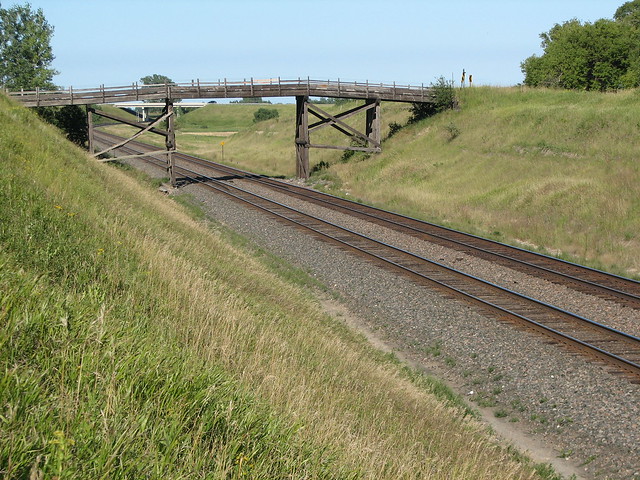
It seemed that my layout needed a miniature version of this overpass. After a perfunctory search of the internet I was not successful in finding any good pictures of the bridge. As a result I decided to try modeling one of the wooden bridges at Hawley, MN since I did have a photo of this taken a few years ago that would give me something to work from.

East Wooden Bridge at Hawley
Wrong state, wrong bridge!

After posting a picture of what I was up to on Facebook, I noticed a comment from Chris Atkins, who is also modeling this section of railroad (plus a lot more!) asking if I intended to model the bridge at Parkman. When I answered yes, he offered up numerous photos of the bridge which revealed a lot of detail, including these found on bridgehunter. Turns out my attempt to use the bridge at Hawley as a prototype was way off base.

You're doing it wrong

The bridge at Parkman is not only completely different, it is more interesting as it contains a pony truss and railroad rails as part of the support elements. Perhaps the most striking difference, to my eye, is clear in this photo. Rather than three straight sections with angled transitions between them, this bridge looks to have a more gradual curving line up and over the tracks. Which presented a problem from the modeling perspective, as in how do I create this gradual curve when all I have to work with is straight pieces of miniature lumber?

So I sat down to think. And ponder. And after extensive contemplation, I came up with the idea of soaking the tiny timbers in hot water followed by a drying session in a jig that held them in the bent position. Here are the main timbers in the jig as they dry.

Got carried away with the paintbrushes

And here are the results after drying overnight. The curve held well when removed from the jig!


In fact, it looks like my first attempt may have been bent too much. I certainly didn't expect that, but with this square timber priced at 79 cents at Hobby Lobby, I guess I can make an adjustment to the jig and try again.


After reviewing the scene, it's clear that I need to make the fill on each side of the bridge have more gradual slopes. So it will be back to the drawing board when I get time to work on the layout again.

Finally, one more shout out to Chris Atkins. Without his help I would still be trying to jam west-central Minnesota into Wyoming. Thanks again, Chris, the photos and assistance are greatly appreciated!

Monday, May 23, 2016

Incremental Improvement

Sometimes progress comes in great leaps, and other times (likely usually) it comes in tiny, nearly undetectable nudges in the right direction. Last night the progress fairy visited me and dropped a helping of the latter. 

As part of my layout reconstruction, I have spent the last few weeks working on a staging yard. Now since this will be just below the operating level of the layout, it needs to be complete before I can take another step. That means not just track laid, but also switch controllers and feeders installed, track joints soldered, and enough trains run through to prove the trackwork is good, as it won't be easy to access once the top deck is in place. 

The track is all down, and the switch ladders are built, so I have set to putting in the classic electrical box controllers. Below is a view of one that I pulled off the old layout. Now understand, these are the best solution to controlling turnouts I have stumbled upon. I drill a hole through a dowel, push the free end of the wire through the hole, and bend the wire to hold it in place. But there is still room for improvement. I got to thinking. Never a good thing. 


Below is a view of the bronze wire I have used to engage the throwbar on the turnout and the handle of the switch in the past. One of the issues this poses is there is nothing to resist lateral force that can make the wire move sideways, and in extreme cases even disengage from the throwbar as it drops down. This is generally known as a bad thing. Takes lots of fiddling to get it back in place.


So I sat and I thought...how can I make this work better. And I had a light bulb moment. The result of this revelation is below. Two extra bends create a situation where the wire is restrained from moving in one direction laterally, and after the dowels that operate the switches are installed, it won't be able to move in either direction. Eureka, I said!


So here is what the new assembly looks like after everything is put together, ready to install under the layout. Not much of a change, but it makes a significant difference in the stability of the whole thing. Notice that I tightened up the spacing between the vertical portion of the wire and the side of the switch as well. This was partly due to a dandy little pair of pliers I scored for four bits at a rummage sale, with jaws just the right width to make this bend.


Mr. L4T is a happy camper!

Now for those who have read this far, a bonus pro tip. I used to struggle mightily getting the screws into holes in the junction box while holding everything in place. The I said, forget the holes and just drive a screw THROUGH the jbox and into the plywood. Turns out this is much easier, on the patience supply and the spine. Eureka, I said again!

Ain't progress grand?

Saturday, January 2, 2016

Coincidence?

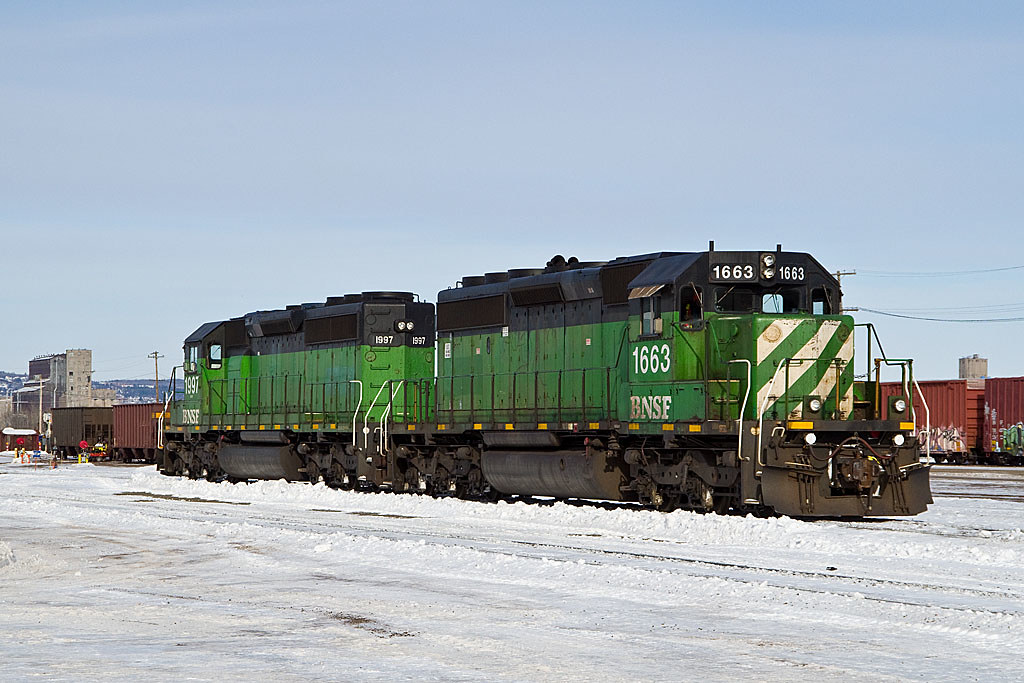
Having posted some pictures to my Flickr account a couple of days ago, I was looking through older images and came across this one, of BNSF 1663 in Superior a couple of years ago (January 20, 2014, to be exact). While not an interesting shot, it is the first one I took with my latest Pentax, which makes it a little special to me. 


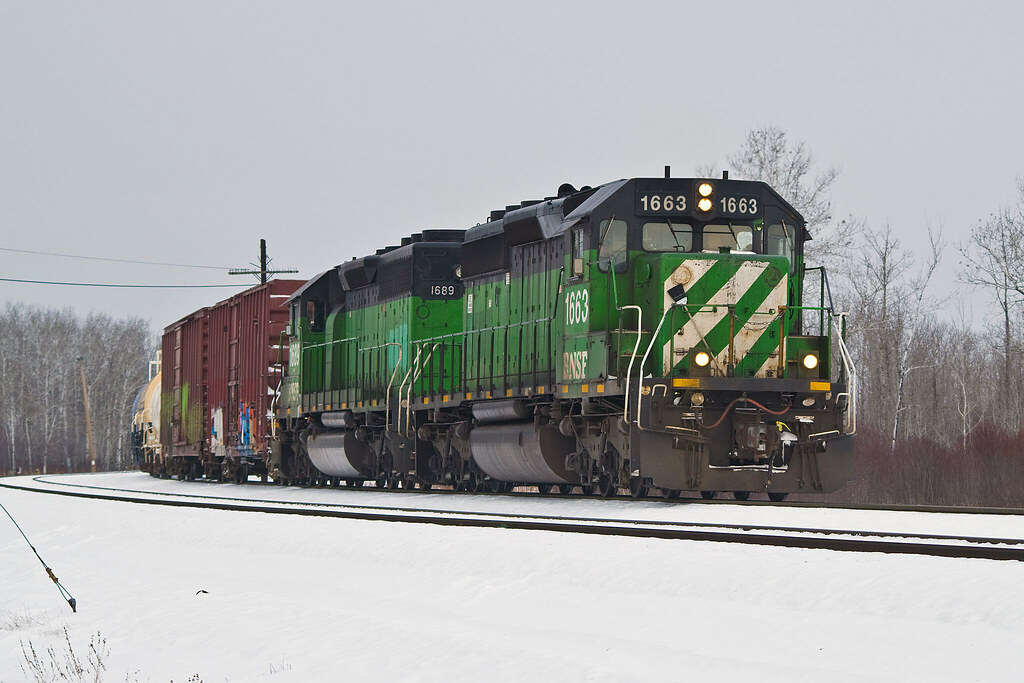
Which brings me to New Year's Eve, 2015. While a bunch of us were waiting for BNSF to head for Northtown with a special movement of refinery equipment, we had the chance to shoot the Rapids Local as it left town. Turns out the lead unit was familiar. 


It's little things like this that make railfanning such an interesting hobby to me. And the only way to make them happen is to keep looking for trains!

Tuesday, December 29, 2015

Twin Ports Oddities and More

Well, maybe not all "oddities", but in a few cases, certainly, "things I don't see every day". 

I slipped away this afternoon for a short jaunt around Duluth and Superior, intent on finally taking a few train photos. My first stop was Rice's Point, where I found the CP local power gurgling away on the lead to one of the Port Authority tracks. The most unusual unit for me in this day and age was the SOO.


Just turning around, I spotted this thing in the yard. Now we're getting somewhere on the oddity front. Not sure of the heritage of this former caboose, but it's sure not something I see often, or even ever before. 


TEXX is a logistics outfit that arranges transportation for unique cargoes, according to their website. The unique cargo in this case might be the heavy load shown below, which was spotted in CP's Rices Point yard a couple tracks over from the caboose. 


With those shots in the bag, I headed to Superior, and swung by the BNSF facility. That's where I spotted these freshly painted sno-dozers, waiting patiently for mother nature to provide the conditions that will allow them to strut their stuff. I'm waiting too!

 
Then it was on to the yard, where I spotted a couple of BN grain hoppers coupled next to each other. The difference in paint condition was enough to get me to stop. These photos will go a long way toward helping me get the weathering right on some models in the future. It is amazing how almost anything I can imagine can be found on the railroad in one way or another. A great example of life imitating art.


Finally, after getting a text from Mrs. L4T recalling me for more mother in law moving duty, I started back for Duluth. As I crossed the yard on the 21st Ave viaduct, I spotted a train that forced me to make a short detour. It's not everyday that you can see a pair of former bluebonnet GP's handling a coal train. OK, it wasn't actually an entire train, but it was a goodly sized cut of coal gons, and while the power was another example of why the Twin Ports might be the world's EMD capital, this specific power set-a GP50 leading a GP40X-is anything but common. It was enough for me to call it an oddity, and a day. 


Friday, August 21, 2015

Kickin' the Anthill

Wednesday was the start of a brief vacation break for me, after a hectic couple of weeks. Since I hadn't been to International Falls, where my parents and my sister and her family live, I decided an overnight jaunt was in order. Wednesday morning I headed north under heavy clouds and light rain. 

I stayed on Highway 53 all the way, so the only chances I had for rail action early in the trip were overpasses, which came up empty. However, with the Ash Lake area yet to come I hadn't yet given up hope of shooting a train in the rain. Sure enough, the first signal south of that siding was glowing red as I approached.

In a few moments a train appeared, headed south. I made a quick u-turn and high tailed it back to Cusson in time to get this shot, as the train sped out of the gloaming. Wow, a pair of GE's. 


I quickly resumed my northward journey, and just as quickly aborted it, as a second southbound was right on the blocks of the one I had just captured. One more quick reversal of course yielded this shot. Three GE's this time.


And once again I started north, but made it only as far as the actual Ash Lake when a northbound appeared beside me, accelerating out of the siding. One more stop allowed me get this train, which won the GE championship for the day with 5 big units up front. 


And then I continued north. 18 minutes first shot to last. Not bad work for one kick at the anthill.

Sunday, February 1, 2015

More Operations

A couple of days after last weekend's shakedown op session on my layout, Dan Mackey sent out a text announcing a trial run on his huge, still under-construction WC layout. I snapped up the invite and planned for a fun evening with a group of like-minded model railroaders. 

I showed up last night to join an enthusiastic group looking forward to giving what Dan has built so far a good workout. Although I would estimate that much less than one quarter of the track is laid (probably safe to say less than 10%), there was plenty to keep four or five operators busy. One thing this tells me is that Dan is building a railroad that will accomodate lots of operators once it is complete. 

One of the locations Dan has been working on is the trackage for the Biron paper mill, seen in the photo below. Matt and Don are working the mill with a GP30, lining up a train for me to pick up after I drop another cut for them to sort and deliver.
My power set for the evening, as I lugged cars back and forth between Stevens Point and Wisconsin Rapids, was this stellar set of high-hood SD24's. While in real life, these units were not popular with all those asked to operate them (as I learned in exquisite detail from Kent Rengo-I got the impression they pulled like Yugos and smoked like Alcos), in Dan's model world they are great pullers in the hands of the right engineer (namely, me). At least until you try to bring 28 or so cars up the helix with them, at which point you will stall, end up doubling the hill, and clog up the mainline for an hour or so to the consternation of the Trainmaster. Live and learn, is one of the adages I live by. Although you wouldn't know it by the stupid expression on my face.
 Speaking of the Trainmaster, here he is. Most likely he is dreaming up some near-impossible mission for the haggard crews to carry out. Something like requiring us to swap ends on a long train, while making sure the tank cars meet all hazmat rules, but without providing a runaround track. Whatever the latest "Mission, Impossible" is, it's guaranteed to make your head hurt.
 Kent and I chatted about train length while I ran my final train down the helix. One nice thing about a helix-it gives you a moment to think as the train winds its way up or down. In my limited operations experience, any free time you can devote to thinking and planning on how you will get your work done, safely and efficiently, is precious. I don't do a good enough job using my thinking time, which can result in embarrassing events like when I ran through a switch that was lined wrong and shorted out half the railroad last night. Events like that will earn you a nickname. They should inspire a motto as well, something like "Slow down and double check the switch."
After the work was done, Dan sat us down to pick our brains about the layout and any suggested changes. The session really showed how his construction techniques result in a dependable and smoothly operating layout. Unlike my session last week, derailments were rare as hen's teeth. Everyone had a good time, although there was a moment when the lack of a runaround track did result in raised hackles, but with some professional railroading advice, we managed to work through it. 
I'm looking forward to doing it again. When this layout is done, Dan will have to bus in people to keep it all operating. It's gonna be a sight to see, that's for sure!